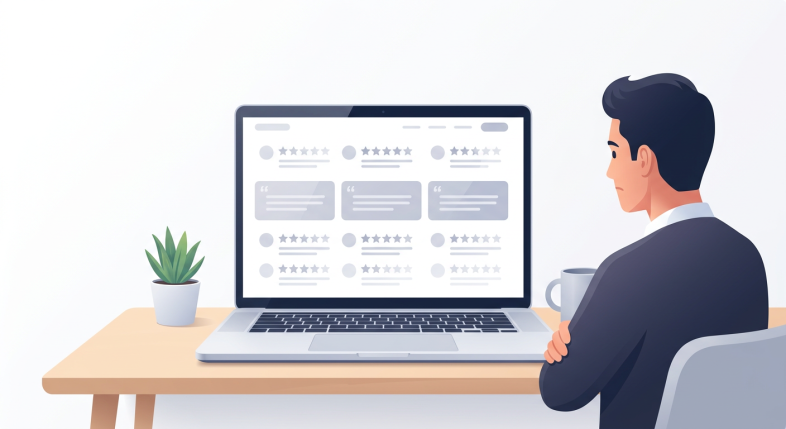
When did you last read a testimonial on a sales page and actually believe it?
If you had to think about that for a moment, you are not alone. Something has quietly shifted in how buyers process social proof online, and if you sell digital products, this shift is costing you sales right now whether you realise it or not.
For years, testimonials were the cornerstone of online trust. The logic was simple: if real people say it worked for them, a new buyer is more likely to take the leap. And for a long time, that logic held up. But the environment has changed around us, and testimonials as a trust signal are losing their grip.
Here is why that matters, and what actually works instead.
The reason testimonials lack authenticity today is not complicated. AI content tools now build entire sales pages, complete with testimonials, in under a minute. Those testimonials are fabricated. The names are made up. The results are invented. And buyers, even those who could not explain exactly why, are starting to feel it. The pattern-matching part of the human brain is remarkably good at detecting when something feels off, even when it cannot articulate what.
So readers skim the testimonials section, absorb nothing from it, and move on still unconvinced. The social proof that was supposed to close the trust gap has become wallpaper.
This is not a small problem. Think about the mental position your reader arrives with before they even see your page. Most people assume, at some level, that whoever is selling something is overstating it. Not because they think you are a bad person. It is just the default setting that years of marketing has trained into them. You are already swimming upstream before you write a single word. Testimonials used to help you swim. Now, in many cases, fake ones have muddied the water for everyone.
Statistics do not rescue you either. We have all watched numbers get stretched and twisted to say whatever the seller needs them to say. A drug tested against an older version goes from 5 percent effective to 10 percent effective, and the marketing calls it 100 percent more effective. Technically accurate. Practically misleading. Readers have absorbed enough of this to be suspicious of any stat that sounds too clean or too convenient.
So if testimonials lack authenticity and statistics lack credibility, what actually moves a cautious buyer?
The most honest answer is experience. Not reading about a result, but having one. When someone tries your product and it does what you said it would do, no testimonial is needed. The proof is in their hands. The trust gap closes itself because there is no longer a gap, only a result.
For physical products, this is genuinely tricky. You cannot easily let someone trial a product that requires manufacturing and shipping. But for digital products, PDFs, video courses, training materials, the trial model is entirely achievable. The obstacle has always been the mechanics: how do you give someone real access without simply giving the product away? How do you automatically revoke that access, or process a refund, without spending your evenings doing it manually?
That is the problem I built PayLocker to solve. You set the trial window, and the system handles the cutoff or the refund automatically. No chasing people. No manual policing. The buyer gets a genuine experience of your product, and if it delivers what you promised, they buy. If it does not, they do not. Either outcome is honest, and that honesty is exactly what makes this approach so effective.
When the mechanism removes the need for persuasion, you stop needing to convince anyone of anything. The product makes its own case.
This matters especially for anyone selling to an audience that has seen a lot of online marketing and developed a finely tuned radar for anything that feels off. If your buyers are in their forties, fifties, or sixties, they have been marketed to for decades. They have seen testimonials evolve from handwritten letters to stock photos with five-star ratings to whatever AI generates today. Their scepticism is earned, and it deserves a real answer rather than another layer of social proof that looks like everything else they have already dismissed.
Giving them a trial gives them control. And people who feel in control are far more likely to buy, because buying feels like a decision they made rather than something they were talked into.
If you sell anything digital and you are still relying on testimonials to carry your sales page, it is worth asking whether those testimonials are doing the work you think they are. Because the trust environment has shifted, and the sellers who adapt to that shift are going to have a significant advantage over those still running the same playbook.
You can see how I set this up for my own digital products here: