
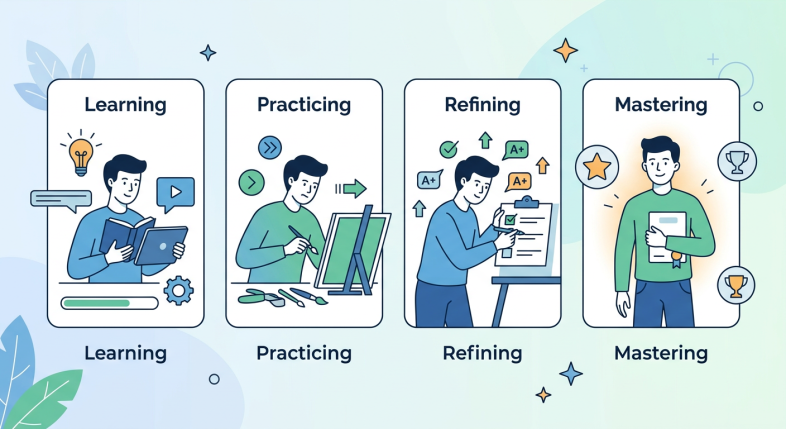
When most people decide to learn a new skill, they picture months of study, practice, and grinding through tutorials before they can do anything useful. And for a long time, that was roughly accurate. But the fastest learners I have ever come across do not work that way at all.
They identify the 20 percent that produces 80 percent of the results, and they stop there. They reach a level called good enough, and then they actually use the skill. The fine-tuning, the mastery, the remaining 20 percent of results that takes years to achieve, they leave that for the people who enjoy that kind of thing. Most of us just want the skill to work for us.
This approach has a name. You have probably heard of the Pareto Principle, or the 80/20 rule. It was originally an observation about economics but it applies almost everywhere in life. In most skills, 20 percent of the techniques, habits, or fundamentals will account for 80 percent of the outcomes. The challenge has always been working out which 20 percent that is.
That used to require years of trial and error, or access to someone experienced who could point you in the right direction. Now there is a faster way.
Ask AI. And I mean that seriously, not as a throwaway suggestion.
Here is the four-step method I use to learn any skill fast, without spending months getting there.
Step 1 of 4: Identify the skill you actually need
Before you open an AI tool, get specific about what you want to achieve. Not “I want to learn marketing” but “I want to write email subject lines that get opened.” Not “I want to understand SEO” but “I want my blog posts to rank on Google for small niche topics.” The more specific your goal, the more useful the next steps become. Vague goals produce vague results, and that is true whether you are asking an AI or a human mentor.
Step 2 of 4: Ask AI for the 4 core fundamentals
Once you know what you need, open your AI tool of choice and ask it a very targeted question. Ask for the top 4 things that the best practitioners in this skill consistently do. Four is not a random number. It is small enough to be actionable and large enough to cover what actually matters. You are not asking for a comprehensive curriculum. You are asking for the concentrated essence of what works.
For example: ask AI what are the 4 things all the top copywriters have in common. Or ask what are the 4 elements that every viral YouTube thumbnail includes. Or ask what 4 factors the highest-ranking pages on Google almost always share. What comes back will surprise you with how clear and practical it is, when you ask the right way.
I tried this myself with YouTube thumbnails. I asked what the biggest channels consistently put on their thumbnails, and within a few minutes I had a clear, actionable answer. I went from guessing to knowing. That shift alone is worth more than hours of watching tutorial videos.
Step 3 of 4: Focus only on those 4 things
This is where most people trip up. They get the answer and then keep researching, keep reading, keep adding to the list. Resist that. Your job now is to practise the 4 fundamentals until they become second nature. Everything else is noise until you have these locked in. Because once you have the core 20 percent working, the results come. And results are the best teacher there is.
Step 4 of 4: Use the skill before you feel ready
Knowing what to do is half the battle. Doing it is the other half. This is where good enough beats perfect every time. The person who writes their first piece of copy today, even imperfectly, will outlearn the person who spends another three weeks reading about copywriting. Action creates feedback. Feedback creates improvement. Waiting creates nothing.
Now, there is one catch to this whole approach that I want to be honest with you about. AI gives you good answers when you ask good questions. If your prompts are vague or poorly constructed, the output will be average at best. The quality of what you get back is almost entirely determined by how you ask.
I built a prompt guide specifically for Claude, which is the AI I use most for this kind of work. In my opinion Claude produces cleaner, clearer text output than ChatGPT, with less filler. But it responds to a different style of prompting, and once you learn that style, the quality of answers you get is noticeably better. I use this guide almost every day.
If you want to get more out of your AI conversations and use this four-step approach to learn skills fast, this guide is a practical place to start.
Get the Claude prompt guide here: