
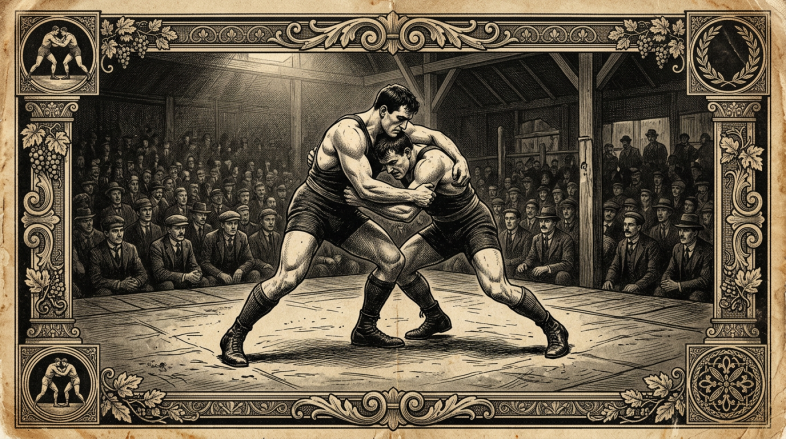
When a wrestling coach from the 1990s decided to sell a course based on a book published before World War One, most people would have told him to forget it. Nobody wants century-old fitness advice. The world has moved on. And yet Matt Furey built a course around exactly that idea, priced it at nearly $300, and has been selling it ever since.
This post is about how that happened, why it still works, and what it means for anyone who wants to build an online product without starting from scratch.
The book Furey found is a public domain wrestling manual, freely available on archive.org. He read it, filmed himself demonstrating the techniques, packaged the whole thing as a video course, and put it up for sale. The book costs nothing. The course costs $297. That gap between free and paid is where the entire business model lives.
A public domain wrestling course sounds like a strange thing to spend money on when the source material is sitting there for anyone to download. But that is precisely the point most people miss. Finding the book is not the product. Packaging it, explaining it, demonstrating it, and presenting it in a form someone can actually use, that is the product. Furey did not sell a book. He sold access to his expertise wrapped around a book, and those are very different things.
What makes public domain material so useful is the absence of cost and legal complexity. Books published before 1928 in the United States, and before equivalent dates in other countries, are generally free to use however you like. No licensing fees. No permissions required. No royalty agreements. You can download the text, adapt it, quote it extensively, or use it as the backbone of an entirely new product.
Project Gutenberg at gutenberg.org and the Internet Archive at archive.org between them hold hundreds of thousands of these texts. The range of subjects is enormous. Fitness, self-defence, farming, cooking, navigation, business, psychology, natural history, carpentry, if people cared about it a hundred years ago, somebody wrote a book about it, and that book is probably sitting in one of these archives right now.
The wrestling niche is a useful case study because it illustrates something about how niche audiences behave. People who are serious about wrestling, or any physical discipline with a long history, tend to be genuinely curious about older methods. They want to know what worked before modern sports science arrived. They find the vintage framing interesting rather than off-putting. A 1914 wrestling manual is not a liability in that context. It is a selling point.
So the first question worth asking is not which public domain books exist, but which niches have audiences who would actually value that historical perspective. Combat sports and martial arts are an obvious category. So are traditional crafts, herbal medicine, homesteading, horsemanship, and old-school physical training. Any discipline where practitioners talk about going back to basics or learning from the old masters has an audience ready for this kind of product.
Once you have identified a subject and found two or three relevant texts, the next step is turning raw material into something useful. This is where a tool like NotebookLM at notebooklm.google.com becomes genuinely helpful. You can feed multiple documents into it and ask it to synthesise the material, identify key themes, suggest a course structure, or draft explanatory content. It will draw on the source texts and supplement them with additional research as it goes.
But this is also where you need to pay attention. NotebookLM is useful precisely because it produces confident, readable output quickly. That same quality makes it easy to accept what it gives you without checking. Every fact it states should be verified. Every claim it makes about a technique, a historical figure, or a piece of advice should be read with scepticism. AI tools are good at sounding authoritative. They are less reliably good at being accurate, and in a physical discipline like wrestling, bad information is not just unhelpful but potentially dangerous.
Proofread what it produces. Rewrite the sections that feel mechanical or vague. Add your own commentary where it matters. The goal is a product that would be worth paying for even if the buyer knew exactly how it was made. That standard is what separates a worthwhile course from a low-effort cash grab, and your audience will know the difference.
The business model underneath all of this is straightforward. Public domain content removes the cost of creating source material from scratch. AI tools reduce the time required to organise and expand that material. Your job is to add the layer of judgement, curation, and presentation that makes it genuinely valuable. When those three things come together well, the result can be sold at a serious price point, as Furey’s course demonstrates.
This approach suits people who already have knowledge in a particular field, because you can recognise what in the old books still holds up and what has been superseded. But it also works for diligent generalists who are willing to research carefully and bring in expert reviewers where needed.
If you want to explore this further, including how to write the prompts that get the most useful output from tools like NotebookLM, my AI Prompt Guide covers exactly this kind of project.
Check it out here:
https://link.ckv.to/prompt-guide
The books are free. The opportunity is in knowing what to do with them.