
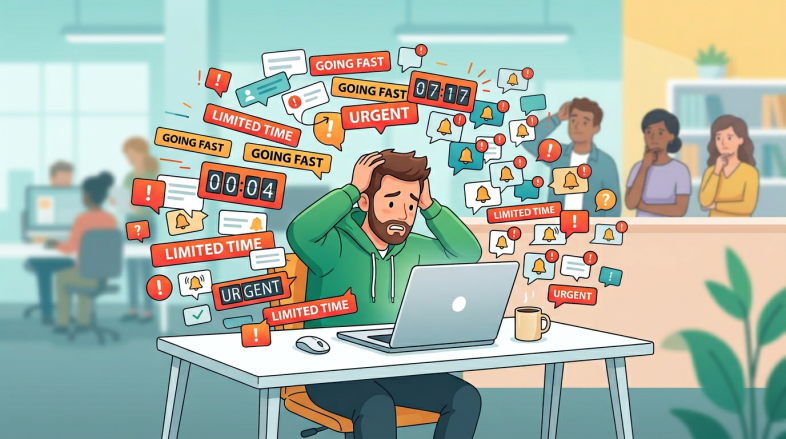
Most FOMO marketing tactics have stopped working, and here is exactly why that happened.
If you have spent any time on email lists or browsing online sales pages, you have seen the same script play out hundreds of times. A countdown timer ticking toward zero. A subject line screaming ‘last chance’. A sales page insisting that only three spots remain, or that the price doubles at midnight.
And if you are anything like me, you have become completely numb to all of it.
That numbness is not an accident. It happened because the tactic was abused so thoroughly, for so long, that the audience trained itself to ignore the signal entirely. When everything is urgent, nothing is urgent. When every deadline is fake, the word ‘deadline’ loses its meaning.
So what actually went wrong with FOMO marketing tactics, and is there a version that still works?
Let me start with what broke.
The fake countdown timer is probably the single most overused and most damaging tool in online marketing. Here is how it works in practice: you visit a sales page, a timer appears showing 47 minutes remaining, you leave the page, you come back two days later, and the timer is sitting at 47 minutes again. Or you clear your cookies and the clock resets to full. The scarcity was never real. The deadline was never real. And once a buyer discovers this, even once, their trust in every deadline they see afterwards evaporates.
This is the core problem with fake scarcity as a marketing tactic. It borrows against your credibility. You might make a sale today because someone believed the timer. But you have also told that person, implicitly, that you are willing to mislead them to close a deal. That is not a foundation most people want to build a business on.
There is also a practical reason fake FOMO has stopped converting the way it once did. Buyers are smarter now. Forums, Facebook groups, and Reddit threads exist specifically to call out dishonest countdown timers and fake scarcity tactics. A quick search before buying is all it takes for a potential customer to discover that your ‘closing tonight’ sale has been ‘closing tonight’ for the past four months.
But here is the thing: the underlying psychology behind FOMO is not broken. Scarcity is a legitimate buying motivator. The problem is not the concept, it is the execution.
When something is genuinely rare, genuinely time-limited, or genuinely available to a limited group of people, buyers respond to that powerfully. Because it is true. And humans are surprisingly good at detecting truth versus performance, especially online, and especially after they have been burned once or twice.
So what does real FOMO marketing look like?
The best example I have come across belongs to a marketer called Tony Shepherd. His approach is almost the opposite of the standard playbook. He releases a product for a few days, sells it to whoever wants it, and then takes it completely off the market. Six months later, maybe a year later, it becomes available again for another brief window, and then it disappears again.
What this creates over time is a list of buyers who are genuinely trained to act when something becomes available, because they know from experience that waiting means missing out for a long time, possibly for good. The scarcity is real. The deadline is real. And the trust it builds is real, because every single time he said the product was going away, it actually went away.
This is the difference between borrowed urgency and earned urgency. Fake FOMO borrows against trust. Real scarcity builds it, because you are demonstrating through repeated honest behaviour that your word means something.
Now, most of us are not going to build a product library and rotate releases on a twelve-month schedule straight away. But there are simpler ways to apply this thinking to your own business.
If you are running a genuine launch with a real close date, hold the close date even when it is uncomfortable. Especially when it is uncomfortable. Every time you extend a deadline because sales were slower than expected, you are training your audience to wait, because they now know the deadline is negotiable. When you hold the line, even once, even if it costs you a few sales, you earn something more valuable in the long run.
If you use a countdown timer on your pages, use one that is actually honest. There are tools available now that assign a real, individual deadline to each visitor based on when they first arrived, and that deadline does not reset when they clear their cookies or come back in a new browser. This is the same mechanic Tony uses in his own business, just automated for a sales page context. It is real scarcity at a practical scale.
The Evergreen Timer works this way. Each visitor gets a genuine personal deadline that sticks, because the timer is tied to the individual, not the page. If you want to use urgency honestly in your marketing without burning trust, it is worth looking at.
Check out the Evergreen Timer here:
https://wm-tips.com/free-timer/?sl=zsPwsNfS
The broader lesson from all of this is one I keep coming back to in online business generally. Short-term tactics that erode trust always feel like they are working right up until they stop working entirely. And by the time they stop working, the damage to your reputation has already been done.
FOMO marketing tactics are not inherently manipulative. Real scarcity is a legitimate, honest reason for a customer to act now rather than later. The question is always whether the scarcity you are presenting is true. If it is, say so clearly and hold to it. If it is not, your audience will figure that out faster than you think.