
When a Sharpie Meets a 3-Year-Old, You Learn a Lot About Marker Stain Removal
My youngest son left a Sharpie within reach of his 3-year-old daughter for about five minutes last week.
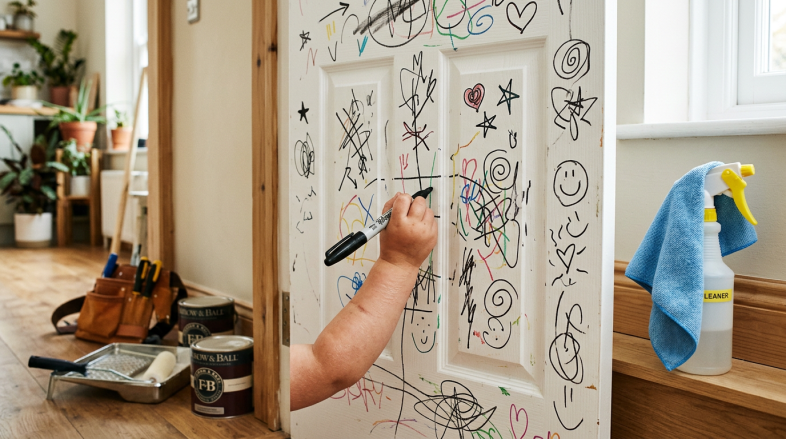
What he came back to was, by all accounts, a magnificent mural on the door.
She had already started trying to clean it off before he got there. And when her own efforts fell short, she roped in the tradie working in the kitchen to help. At three years old, she understood that Sharpie on a door was a problem, and she went about solving it with impressive efficiency.
The tradie probably did his best. But here is the thing with permanent markers: they are called permanent for a reason.
If you have ever faced a similar situation, whether it is a Sharpie, a whiteboard marker, or a texta that found its way onto a wall, a door, a bench top, or a piece of furniture, you already know that warm water and a cloth does almost nothing. The pigment in permanent markers is designed to bond. Getting it off requires something that can break that bond without wrecking the surface underneath.
So what actually works for marker stain removal?
The answer depends almost entirely on what the marker ended up on.
On painted walls and doors, rubbing alcohol is one of the most reliable options. Isopropyl alcohol at 70 percent or higher will lift a lot of permanent marker if you catch it early. Apply it to a cloth rather than directly to the surface, work from the outside of the stain toward the centre, and expect to go through a few cloth sections before it comes fully clean. The risk with painted surfaces is that aggressive rubbing can lift the paint itself, so patience matters more than pressure here.
On timber or MDF doors with a lacquer or polyurethane finish, the same approach can work, but test a hidden spot first because some finishes react badly to alcohol. A product like Goo Gone can also be effective on these surfaces and is gentler than straight isopropyl if you are worried about finish damage.
Whiteboard markers are a different story because they use an alcohol-based ink with a release agent already in them. The old trick of drawing over whiteboard marker with a fresh whiteboard marker and then wiping works because the solvent in the fresh marker reactivates the old one. This does not work on permanent marker, which is a mistake plenty of people make when they are panicking.
For fabric, the approach shifts again. Dabbing with rubbing alcohol before the stain sets is still the first move, but you need to blot rather than rub or you will spread it. Hand sanitiser gel, which is mostly alcohol, works surprisingly well in a pinch and most households have it sitting around.
On hard non-porous surfaces like glass, ceramic tiles, or laminate benchtops, permanent marker actually comes off more easily than you might expect. A dry-erase marker dragged over the top and wiped while wet is effective here. So is a small amount of acetone-based nail polish remover on a cotton ball. The non-porous surface gives the marker nowhere to penetrate, so it sits on top and releases more readily.
The frustrating surfaces are anything porous: raw timber, concrete, uncoated brick, and fabric with a loose weave. On these, the ink wicks into the material and the best you can usually do is fade it significantly rather than remove it completely. Multiple applications over a few days, letting the surface dry fully between attempts, tend to yield better results than one heavy-handed go at it.
My granddaughter’s instinct to start cleaning before Dad got home was the right one. The faster you get onto a marker stain, the better your odds. Once it has been sitting for hours and the solvent carrier in the ink has fully evaporated, you are dealing with dry pigment that has had time to settle in properly.
For what it is worth, she showed more problem-solving initiative than most adults I know. Recognised the issue, attempted a fix, escalated to outside help when her own efforts were not working. At three.
She is going to be a handful at thirteen. But that is her dad’s problem, not mine.
On the subject of tools that quietly handle things in the background so you do not have to, I built an Amazon S3 File Manager that lets you serve any file you like from your Amazon S3 account, from a desktop tool you build from the PDF.
If the link is still live, you can check it out here:
https://link.ckv.to/s3-file-manager
If the timer has expired by the time you get there, just send me an email and ask. I will give you a personalised link good for 24 hours.