
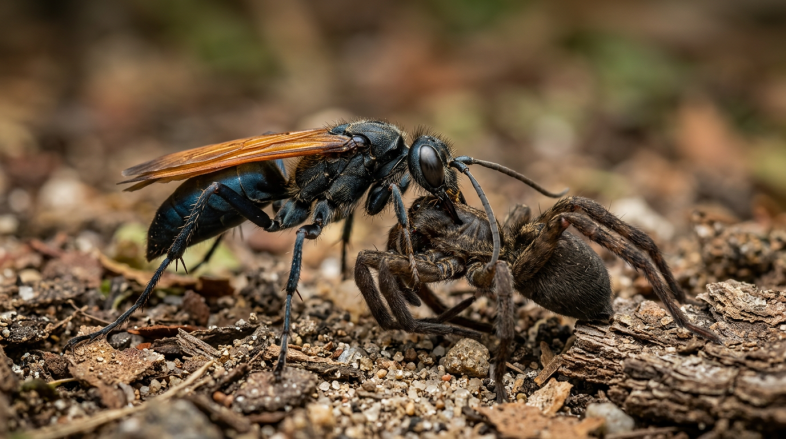
When I was out on the bike track Monday morning, I spotted something strange on the path in front of me.
A wasp was dragging a spider along the ground.
I had to stop and watch. I’ve known about spider wasp behaviour since I was a teenager, but this was the first time I had actually seen it happening in front of me. And it is every bit as unsettling as it sounds.
So here is what actually happens.
The spider wasp hunts down a spider, sometimes one much larger than itself, and engages it in a fight. When the wasp wins, it delivers a precise sting that paralyses the spider without killing it. The spider is still alive at this point. The wasp then drags the paralysed spider to a burrow or some other sheltered spot, lays a single egg on it, and leaves.
When the larva hatches, it begins feeding on the spider from the outside in. Crucially, it leaves the vital organs until last. This is not random. Consuming the non-essential tissue first keeps the spider alive longer, which keeps the food source fresh. The spider endures this until there is nothing left of it.
It is a genuinely gruesome way to die.
But here is the part that stayed with me long after I got back on the bike.
The wasp does not second-guess this method. It does not scout around for a more efficient approach. It does not pause and wonder whether there might be a better burrow location, a faster way to subdue the spider, or a more modern technique it has not tried yet. It just executes the same process, every single time, because that process works.
Spider wasps are found across most of the world, not just Australia. There are thousands of species in the family Pompilidae, and despite the enormous variation in climate, terrain and prey, they all follow essentially the same behavioural pattern. Find a spider. Paralyse it. Provision a nest. Lay one egg. Move on.
The behaviour has not needed updating because it produces results consistently.
Now think about how most people approach building an online business.
They find a method that shows promise, follow it for a few weeks, then spot something newer and shinier and pivot. Then they pivot again. And again. After six months of relentless exploration, they have a folder full of half-finished projects and no income to show for any of them.
The spider wasp does not have that problem. It picked one method and it runs that method to completion every time.
That principle is the first of eight rules inside the 8 rules to build your business, and it might be the one that matters most, especially if you have been building online for a while without seeing the compounding results you expected.
Stop hunting for a better method. Pick one that demonstrably works. Run it to completion. Repeat.
The wasp figured this out a long time before any of us did.
If you want to see all eight rules: