
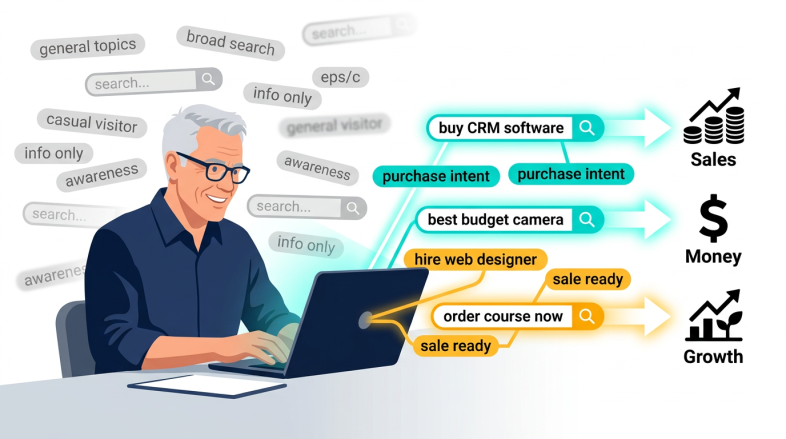
When you type a keyword into a research tool and see a big search volume number, it feels like you have found something. Thousands of searches a month. Traffic waiting to happen. But here is what most people never stop to ask: who is doing all that searching, and what do they actually want?
This is the question that separates people who build online income from people who build online traffic statistics. And they are not the same thing.
I have spent years doing keyword research the conventional way. You pick a topic, you brainstorm phrases, you run them through a tool, you look at search volume and competition, and you try to guess which ones might attract people who will eventually buy something or click something or subscribe to something useful. It is a lot of guessing dressed up as data.
The problem is not the tools. The problem is the starting point.
When you start with a keyword, you are starting with a word. You have no idea what the person typing that word is actually trying to do. Are they curious? Are they a student doing research? Are they a journalist writing an article? Or are they someone with a credit card open in another tab, trying to decide between two options right now?
Search engines call this concept buyer intent keywords, and understanding it changes everything about how you approach traffic.
What are buyer intent keywords exactly? They are search phrases that signal the searcher is close to making a decision or a purchase. Not just browsing, not just learning, but actively looking to act. Think about the difference between someone searching for “what is web hosting” versus “best web hosting for small business under fifty dollars.” Both phrases are about web hosting. But only one of them is likely to convert into a sale, a click, or a lead worth having.
The challenge is that most keyword research still points people toward volume. Big numbers look appealing. But high-volume keywords are usually informational. They attract curiosity, not commitment. And if you build a site full of informational content targeting broad keywords, you will get traffic. You just will not get much to show for it.
This is why so many sites running AdSense earn almost nothing despite decent visitor counts. The visitors are not in buying mode. They read the article, they get the answer they wanted, and they leave. They do not click ads. They do not sign up. They do not buy. Because the keyword that brought them there never indicated they were ready to do any of those things.
So how do you find buyer intent keywords without spending hours filtering through thousands of results hoping to spot the right ones?
The conventional answer is to look for certain patterns. Words like “best”, “review”, “buy”, “cheapest”, “alternative to”, “vs”, and “near me” tend to appear in searches made by people who are evaluating options. These are useful signals. But manually finding and vetting these phrases at scale is tedious work, and even then you are still guessing.
The smarter approach is to flip the process entirely. Instead of starting with keywords and guessing whether they attract buyers, you start with pages that are already proven to attract buyer traffic, and you work backwards from there.
This is the insight that changed how I think about keyword research. If a page is already converting, if it is already sitting in front of people who are spending money, then the keywords driving that page are, by definition, buyer intent keywords. You do not have to guess. The market has already told you.
This approach means you are not researching keywords in the abstract. You are reverse-engineering real buyer behaviour that is already happening. You find where buyers are gathering, look at what got them there, and then build your own content or pages to intercept that same traffic.
For anyone over fifty who is building an online income without a big team or a big budget, this matters enormously. You do not have unlimited time to publish content that goes nowhere. Every piece of content you create is an investment, and you want it working for you, not just sitting there collecting search impressions from people who were never going to do anything.
A few practical things to keep in mind when you are thinking about buyer intent. First, longer and more specific phrases nearly always carry higher intent than short broad ones. Someone searching “affiliate marketing” could be anyone. Someone searching “best affiliate programmes for gardening bloggers” is a real person with a real plan. Second, comparison and review searches are gold. When someone types “product A versus product B”, they have already decided they want one of those things. They just need a nudge in one direction. Third, location-based searches and time-based searches often carry strong intent. “Available now”, “in stock”, “this week” are all signals of urgency.
But again, finding all of this manually is the old way. The better way is to start from what is already working.
If you want to see the method I have been testing that does exactly this, starting from real buyer traffic and working backwards to the keywords behind it, the link below will take you to it. It is currently on launch pricing, which will not last long.
Check out the Traffic X-Ray method here:
https://link.ckv.to/traffic-x-ray
Stop guessing which keywords attract buyers. Start where the buyers already are.