
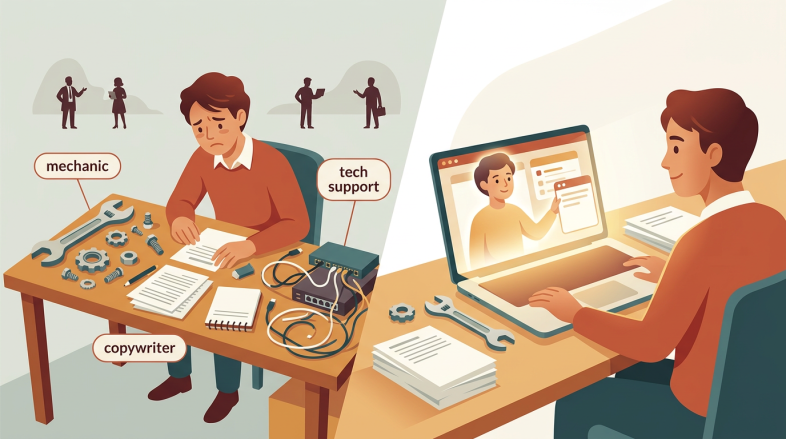
When you try to hire skilled professionals, you quickly discover that finding someone genuinely good at their job is harder than it should be.
John Cleese once claimed that only about one in seven people in any job truly knows what they are doing. His therapist, apparently, thought the ratio was even worse in her own field, closer to one in ten. That observation stuck with me because I have seen exactly the same pattern across multiple industries over many years.
My mechanic of 20 years retired recently. He was one of that rare one-in-seven. Fair prices, honest work, never invented problems to pad the bill. When he retired, he would not tell me who he recommended as a replacement. So now I am back to the uncomfortable process of finding someone competent, which anyone who has been through it knows is not straightforward.
I ran into the same thing when I worked as an office equipment technician. A significant portion of the jobs I attended were there to fix what another technician had already done wrong. This was not occasional. It was a pattern.
So when people talk about how hard it is to hire skilled professionals, I do not think they are being overly critical. The honest reality is that genuinely skilled people are a minority in most fields, and the gap between someone who looks competent and someone who actually is can be expensive to discover.
But here is where things have shifted.
AI tools have changed what you need to outsource, and what you can handle yourself, even if you have never done it before. You do not need to hire a copywriter for every piece of content. You do not need a specialist to draft your email sequence or structure your lead magnet. AI can do a credible job of most of those tasks.
That said, AI is not a replacement for thinking. It is more like a capable apprentice who learned everything from the internet, which means it absorbed a lot of misinformation along the way. It will occasionally make things up when it is uncertain, because that is what it was trained on. So you still need to cross-check, correct, and guide it.
The way to get good results from AI is to treat it the way you would treat a new apprentice. You would not hand a new apprentice a vague instruction and expect a perfect outcome. You would explain your business, your tone, your standards, and what you actually need. The more context you give, the better the work you get back.
This is exactly why I built the Prompt Architect process. Before it writes any prompts, it asks you about your business. The result is a set of prompts built specifically around what you do, not generic templates that could belong to anyone.
If you have been frustrated by AI giving you outputs that feel off-brand or just a bit flat, the problem is usually the prompt, not the tool.
Build the one tool that creates prompts specifically for your business: