
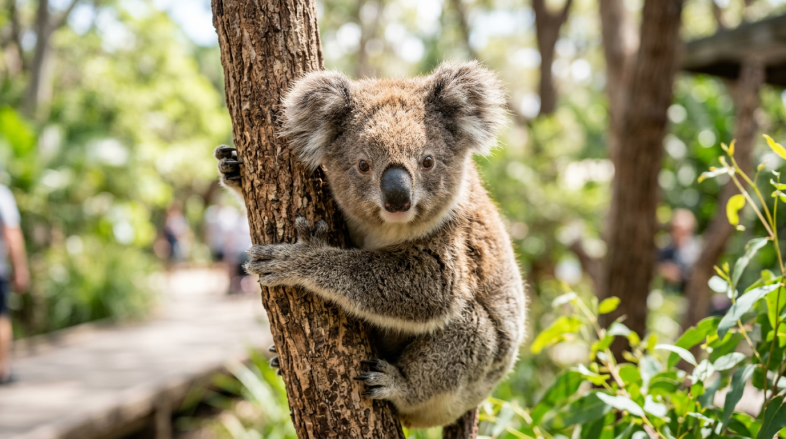
When you live in a city, you stop expecting the unexpected. You know the footpaths, the traffic, the neighbours. And then one morning a koala is blocking your track, staring at you like you are the one in the wrong place.
That happened to me recently. I ride regularly through a heavily urbanised part of Adelaide, and whilst kangaroos and snakes are a fairly ordinary sight out on the trails, a koala is something else entirely. They are not abundant in this area. Seeing one is not unheard of, but it is not common either. This one was simply sitting on the track, completely unbothered, until it decided to make a quick bolt for the nearest tree and climb up to about head height. Once it was satisfied the threat had passed, it climbed back down and went about its business.
The whole thing was fairly uneventful. But it stuck with me, because urban wildlife encounters like this one are a good reminder that the natural world has not gone away just because we built suburbs over the top of it.
Australia is one of those places where the wildlife genuinely does not care about your plans. Kangaroos will idle across a road at their own pace. Snakes will sun themselves on a warm path and expect you to go around. And koalas, for all their dopey reputation, are not the cuddly creatures that overseas visitors often imagine them to be. Cute, yes. Cuddly, no.
You can hold a koala at certain wildlife parks and zoos where one animal has been specifically trained and temperamentally suited to that experience. But a wild koala is a different proposition entirely. Even if you could catch one, which is genuinely unlikely because they move faster than people expect, you would not enjoy what followed. They have strong claws and considerable strength for an animal their size. You would survive the encounter, but perhaps a little the worse for wear.
This is true of most Australian wildlife. The animals here are not aggressive by nature, but they are not domesticated either. The contract they offer is simple: leave them alone and they will leave you alone. It is a fair deal, and one that works well for both parties.
Urban wildlife encounters are becoming more discussed as cities expand into habitat and animals adapt to suburban environments. What used to be a purely rural experience is now something that happens on bike tracks, in backyards, and along creek lines threading through residential areas. Koalas, in particular, are increasingly being spotted in places where they were not recorded a generation ago, partly due to habitat pressure and partly because populations are slowly recovering in some regions after years of decline.
If you come across a koala, or any Australian native animal in an urban setting, the best approach is to give it space and time. Watch from a respectful distance. Do not attempt to handle it, feed it, or guide it. If the animal appears injured or distressed, contact your local wildlife rescue organisation rather than intervening yourself. They have the training and equipment to help without causing further stress to the animal.
For me, it was just a Friday morning ride with an unexpected encounter. But it was a good reminder that even in a built-up area, you are never entirely separate from the natural world. Sometimes it turns up on the track ahead of you and makes you stop for a moment.
If you are interested in more of my observations on life, business and building income online, your source for marketing information is below: