
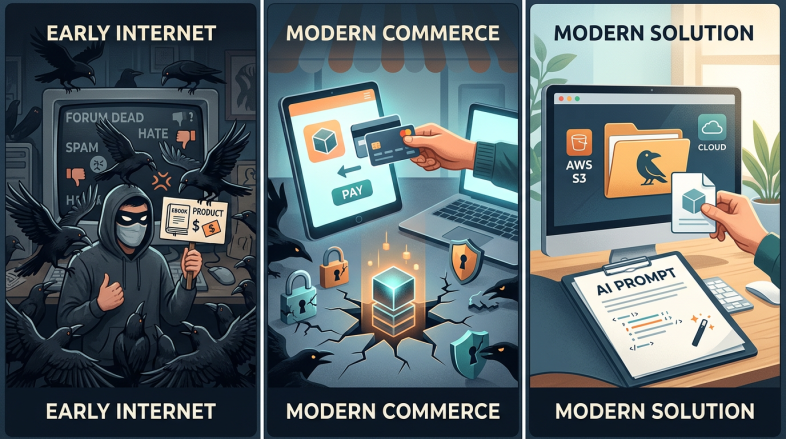
When selling online could get you mobbed
If you were online in the early days of the internet, you know it was a very different place. Not just technically different. Culturally different. And if you dared to offer something for sale in a forum or newsgroup, you learned that lesson fast.
This is something I experienced firsthand. And to explain what it felt like, I keep coming back to crows.
There is a well-documented experiment where a researcher captured a crow, caged it briefly, and then released it completely unharmed. The researcher was wearing a costume during the capture, complete with a mask. Because here is the thing about crows: they recognise individual human faces. The mask was not a theatrical choice. It was survival.
From that point on, every time that researcher stepped outside wearing the same costume, crows mobbed them. Not just the crow that was captured. Other crows. Young crows that were not even born yet when the original incident happened. The memory was shared and passed down for over a decade.
Early internet flaming worked almost exactly the same way.
If you posted anything that looked like a sales message in the wrong place, the pile-on was immediate and merciless. People who had never seen your page, never read your offer, never interacted with you at all would join in. The outrage spread. It was tribal, it was swift, and it had very little to do with what you actually said.
I had to learn to put on a mask and a costume just to operate online. Not a literal one, but the metaphor holds. You could not simply show up as someone with a product to sell. You had to disguise your intent, approach sideways, and hope the mob did not recognise what you were doing.
Tossers, the lot of them. But that was the culture.
Things are genuinely different now. Selling online is normal. Nobody gets flamed simply for having something to offer. The internet grew up, commerce became part of the fabric of the place, and most of the old guard who enforced those unwritten anti-commercial rules have long since moved on.
But some things are still harder than they should be.
Product delivery, for instance. If you have a digital product to sell, getting it into the hands of paying customers without it leaking everywhere is still a genuine problem. There are platforms built to handle this, some with security, some without, and most of them cost you ongoing money and time.
The most robust solution I have found is Amazon S3. It is solid, reliable, and scales without drama. But the permissions system is clunky by default. S3 defaults to private, which is sensible for storage, but means you have to manually adjust settings every time you want to deliver something to a customer. It is manageable once you know what you are doing, but it is the kind of repetitive messing around that quietly drains your day.
So I built a desktop tool that acts as an interface to S3. You do the initial setup inside the Amazon ecosystem once, and after that you manage everything from your desktop as if S3 were just another folder on your computer.
I am not selling the tool. What I put together is a PDF with the prompts you need to build this yourself using Claude. Building it yourself means you can customise it to fit your own workflow rather than being stuck with decisions I made for mine. The prompts may work with other AI tools, though I have only tested with Claude.
You can have it running in under an hour.
Get the Amazon link to S3 File Manager here:
https://link.ckv.to/s3-file-manager
Note: the link above was built with the desktop tool itself. It is a temporary link and expires Wed 23 Sep 2026, 11:30 PM (ACST).