
If you have ever stared at an error message and thought ‘that tells me absolutely nothing’, you are in very good company.
Software installation error messages are one of the great unsolved frustrations of the digital age. Not because they are rare, but because they are almost universally useless at the moment you need them most.
I ran into a classic recently. I was trying to log into a website and the message I got back was this: ‘Please correct the following error(s): An unknown error has occurred.’ That is not an error message. That is a shrug with a border around it.
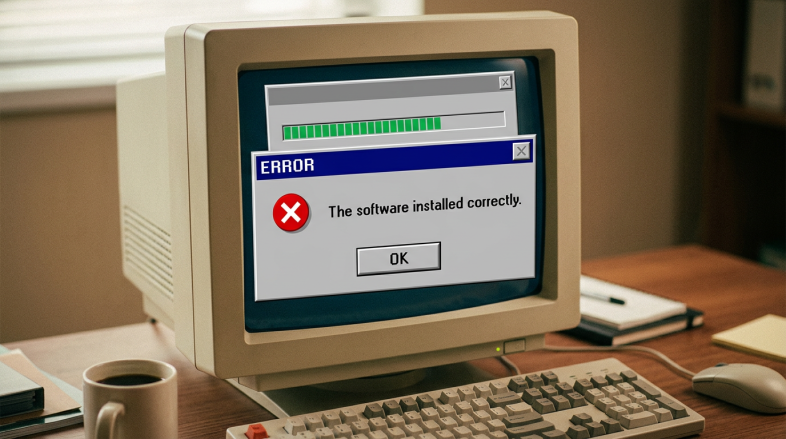
But it reminded me of my all-time favourite, which I encountered years ago whilst installing a program on an older version of Windows. The error message box appeared on screen and displayed, in bold, official-looking text: ERROR: The software installed correctly.
Read that again. The software installed correctly. Flagged as an error.
Apparently that was a novel enough outcome for Microsoft at the time that the system did not quite know how to handle it. And this is not as unusual as it sounds. Windows has an official error code for success. It is number 0. The fact that success has its own error code tells you a lot about how these systems are built.
So why does this happen?
When developers are building software, they write placeholder error messages as they go. The idea is to come back later and replace them with something specific and useful. Sometimes they forget. Sometimes they run out of time before a release. Sometimes the message box was originally meant to flag a failure, and the logic changed but the message text did not. The result is that users end up reading error messages that are either misleadingly vague, technically backwards, or simply left over from an earlier version of the code.
This is not unique to small developers or hobbyist tools. It happens at every level of the industry, including at the largest software companies in the world. Building software that correctly anticipates and labels every possible failure state is genuinely difficult. The error handling logic can be as complex as the software itself.
That is partly why every piece of commercial software ships with an End User License Agreement, the EULA. Most people click through without reading a word of it, which is understandable because they are written in legal language and tend to run for pages. But the core message of nearly every EULA can be condensed into a few sentences. We built this carefully. If it works, wonderful. If it does not, we are not liable.
In other words, the EULA is the official, legally-sanctioned version of ‘An unknown error has occurred.’
None of this is said to be cynical about software. I use it every day, and most of it works remarkably well most of the time. But it is worth understanding why error messages so often fail to help you, because knowing that makes it less maddening when it happens.
When a program tells you nothing useful, it is usually because someone planned to come back and write a proper message, and did not. When it contradicts itself, it is usually because the logic changed after the message was written. And when the EULA covers the gap, that is by design.
If you are building something of your own and want it to actually do what it says on the label, that is the standard worth aiming for. Make your PDFs look as good as the content: