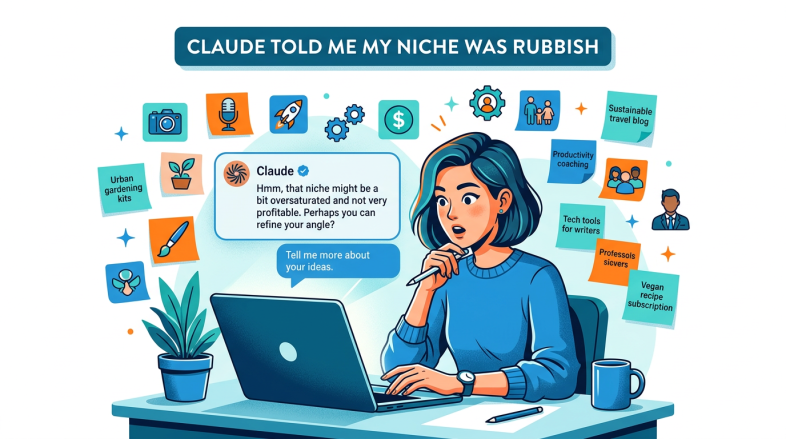
When an AI tells you your niche idea is rubbish, you have two choices. Take offence, or take notes.
I took notes. And what came out of that conversation ended up being a working website with 18 pages, built in a day and a half, without a developer, without WordPress, and without me leaving the house because I had a cold.
Here is how the whole thing actually worked.
I started by pulling keyword and traffic data for a niche I had in mind. Real data, not guesswork. I used a dedicated tool to get search volumes, competition levels, and demand signals for that topic. Then I fed that data directly into Claude, the AI assistant, and asked for an honest assessment.
Claude was honest. It told me the niche I had chosen was weak. Too broad, too competitive, not enough of a clear audience. But instead of leaving me stuck, it suggested alternatives based on the data I had given it.
This is the part that matters most, and it is worth slowing down on. I did not ask Claude to guess. I gave it real numbers and let it reason against those numbers. That is what makes this a genuine AI niche validation tool rather than just a chat session. The AI is only as useful as the data you bring to it.
So I ran the keyword tool again on the alternative niches Claude had suggested. Fed that second round of data back in. The picture got much clearer. Between the two of us, Claude and I settled on a niche and a site structure that actually made sense against the traffic evidence.
If you are wondering what niche I landed on, the site is live at https://instagram.wm-tips.com/ and you can have a look. But I want to be honest with you: the niche itself is not really the point. If you like it, great. If you do not, that is fine too. What matters is the process that produced it, because that process works regardless of what you are building.
How to use an AI niche validation tool without wasting your time
Most people who try to use AI for niche research make the same mistake. They open a chat window and type something like, “What is a good niche for me?” and then wonder why the answer feels generic and useless.
The reason it feels generic is because it is. You gave the AI nothing to work with, so it gave you nothing useful back.
The approach that actually works is different. You bring data first. Use a keyword research tool, whatever one you have access to, and pull real traffic and competition data for the niche you are considering. Then give that to the AI and ask it to assess what you have found. Ask it to spot weaknesses. Ask it to suggest variations or alternatives. Then go and validate those alternatives with the same tool and bring that data back.
What you are doing is using AI as a reasoning layer on top of real evidence, not as a guessing machine. That is the difference between an AI niche validation tool that produces results and one that produces generic lists.
The site itself: no WordPress, no developer, no drama
Once the niche was settled, I built the site in Claude Code. It is not WordPress. It runs on Cloudflare as a dynamic JSON site, staged through GitHub. It loads faster than a typical WordPress installation and cost me nothing in hosting beyond what I already had.
Start to finish, 18 pages and one banner image took a day and a half. I was sick at the time, which tells you something about how much heavy thinking was involved.
I am not going to hand you my exact prompts, because they were written for my specific project and they will not fit yours. What I can tell you is the general approach: open Claude Code, describe what you want to build, ask it to guide you through the steps, and when something goes wrong, report the error exactly as it appears and ask what to do. Claude Code is surprisingly good at debugging its own suggestions when you give it accurate feedback.
Why niche validation matters before you build anything
Building a site or a product without validating the niche first is one of the most common and most expensive mistakes people make in online business. Expensive not necessarily in money, but in time. Months of work aimed at an audience that is either too small, too hard to reach, or already saturated with competition.
A good AI niche validation process does not guarantee success. But it does filter out the obvious mistakes before you invest your time. It gives you a reason to proceed, or a reason to change direction, before you have committed to anything.
For anyone building their first micro-niche site, or their fifth, this kind of structured AI-assisted research is worth doing before you register a domain name.
One more thing before you go
If you want your prompts already structured and aimed at your specific niche and audience before you even start a conversation with Claude, I put together a guide that does exactly that. It walks you through setting up your AI prompts in a way that is tailored to your project from the start, which saves a lot of back and forth.
You can find it here: