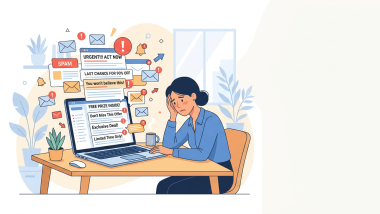

When you type a question into Google or hit play on a YouTube video, you are trusting that what follows is true. Most of the time, that trust is misplaced.
I want to share something that happened to me recently, because it illustrates a problem that I think is getting worse, not better. I watched a video that confidently explained how a particular mixture of liquids would preserve timber and restore old wood to something close to new condition. I have a deck that is well overdue for attention, so I mixed it up and applied it. It did not work. Not even close to what was promised.
The strange thing is that I was not entirely surprised. After years of searching online for practical information, I have learned to be sceptical. But this time I let my guard down, because the video was well-produced, the presenter was confident, and the comments were full of people saying it had worked for them. And yet, when I actually tested it, nothing.
This is what misinformation on the internet actually looks like in everyday life. It is rarely a dramatic conspiracy. More often it is just someone who tried something once, or heard it from someone else, or simply made it up, and then published it with the same confident tone as someone who actually knows.
Daniel Boorstin put it well: the greatest enemy of knowledge is not ignorance, it is the illusion of knowledge. That line has stayed with me, because it describes exactly what is happening across most of the internet right now.
If I had to estimate, I would say somewhere north of 80 per cent of the content online is opinion dressed up as fact, or at best, secondhand experience presented as universal truth. That is not a figure I can prove. But after years of testing things, watching tutorials, reading guides, and comparing results, it feels about right.
So how do you navigate this?
First, learn to distinguish between a source and a reference. Anyone can write a blog post or record a video. What matters is whether they are pointing back to something verifiable. When I started researching dementia prevention a while back, I made a point of tracing every claim back to its origin. If the trail ended at another blog post or a YouTube channel, I discounted it. If it pointed to Framingham, the NIH, or the University of Queensland, I paid attention. Those are institutions with reputations on the line, peer review processes, and decades of accumulated research. A person filming in their garage does not have the same accountability, and there is nothing wrong with that, as long as you know the difference.
Second, treat online information the way a good mechanic treats a diagnosis. A good mechanic does not take your word for what is wrong with the car. They look, they test, they verify. When I found the wood preservation video, I should have looked for at least two or three independent sources making the same claim before I mixed anything up. Instead, I took a shortcut. The internet rewards shortcuts, but real-world results rarely do.
Third, notice the difference between confidence and competence. This is a hard one, because the most confident voices online are often the least qualified. Misinformation spreads not because people are stupid, but because confident presentation triggers trust. A hesitant expert often sounds less credible than a decisive amateur, especially in a short video format where there is no room for nuance.
This is not an argument for paralysis or endless scepticism about everything you read. It is an argument for a simple habit: before you act on something you found online, ask yourself where it actually came from and whether anyone with something to lose has confirmed it.
For the dementia research I mentioned, the regime I am now following is grounded in real longitudinal studies, not wellness blogs or podcast episodes. My wife is less than enthusiastic about the sardines, but the underlying evidence is solid enough that I am sticking with it.
If you want to see what that research pointed to and what I am actually doing about it, you can find more here: