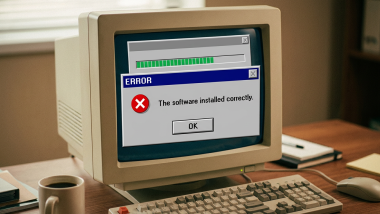

When one small part fails, the whole machine stops, and most online marketers never figure out why
On 28 January 1986, the Space Shuttle Challenger broke apart 73 seconds after launch. Seven astronauts died. The engineers had warned about the problem the night before. They were overruled. And the cause, in the end, was a rubber ring that went stiff in the cold and failed to seal.
That is a brutal example of what happens inside any complex system when one component is ignored. The rest of the system can be working perfectly. The rocket can be fuelled, the crew trained, the mission planned to the finest detail. But if one small part fails at the wrong moment, the whole thing comes down.
Marketing works the same way. And this is what most people miss when they hit a wall.
Marketing system failure is rarely what it looks like on the surface
When an online business stops growing, when sales dry up or never really started, the first instinct is to blame traffic. And traffic might genuinely be the problem. But it might not be. It could be a conversion issue. It could be a product that does not match what the audience actually wants. It could be an email sequence that asks before it gives. It could be a lead magnet that looks like it was thrown together in fifteen minutes, which undermines trust before the relationship has even begun.
The frustrating truth about marketing system failure is that the symptom and the cause are rarely in the same place. You see a lack of sales. You assume it is a traffic problem. You pour energy into driving more visitors. But if the real problem is further down the funnel, more traffic just means more people experiencing the same broken process.
This is why diagnosing a marketing system takes more patience than fixing it.
Every component in the chain carries weight
Think about what a basic online marketing funnel actually involves. There is a traffic source. There is an entry point, a landing page, a quiz, an opt-in form. There is something delivered in exchange for an email address. There is an email sequence that follows. There is an offer at some point in that sequence. And there is a product or service that has to deliver on what was promised.
If any single one of those components is weak, the funnel underperforms. And because most of the failure shows up at the sales end, most people spend their time fixing the wrong end of the system.
I have seen this play out in my own work. A quiz can be a genuinely clever entry point into a funnel because it sorts people, it engages them, and it creates a natural reason to follow up. But a quiz result page that sends a PDF which looks like a school assignment is doing damage at exactly the moment trust should be building. That is the O-ring. That is the component that stiffens in the cold and breaks the seal.
The good news is that once you identify the weak link, the fix is usually simpler than you expect.
What a funnel that gives before it asks actually looks like
The principle is straightforward. Before you ask anyone to buy anything, you give them something genuinely useful. A well-structured quiz does that. A PDF that looks as good as the content inside it does that. When both of those pieces are working, you have the beginning of a funnel built on trust rather than pressure.
This is not a complicated idea. But getting the execution right across every component is where most people run into trouble. The idea is simple. The parts are not.
If you want your PDFs to look as good as the content inside them, this is worth your attention:
Make your PDFs look as good as the content.