
Most people who set big goals never reach them, and it is not because they aimed too high.
It is because they stopped at the goal.
They wrote down the dream, pinned it to the wall, maybe told a few people about it, and then waited for motivation to arrive. When it did not show up on schedule, the goal quietly faded. Sound familiar?
There is a well-known quote attributed to Thomas Edison: “Vision without execution is hallucination.” Whether he actually said it in those exact words is debatable. But the idea is sound, because a goal that sits in your head or on a sticky note without a clear execution strategy behind it is little more than wishful thinking.
This is the piece most goal-setting advice skips entirely.
What a Goal Setting Execution Strategy Actually Means
When people talk about goal setting, they usually focus on making the goal big enough, specific enough, or emotionally compelling enough. And those things matter. But none of them answer the real question, which is: what do you actually do tomorrow morning?
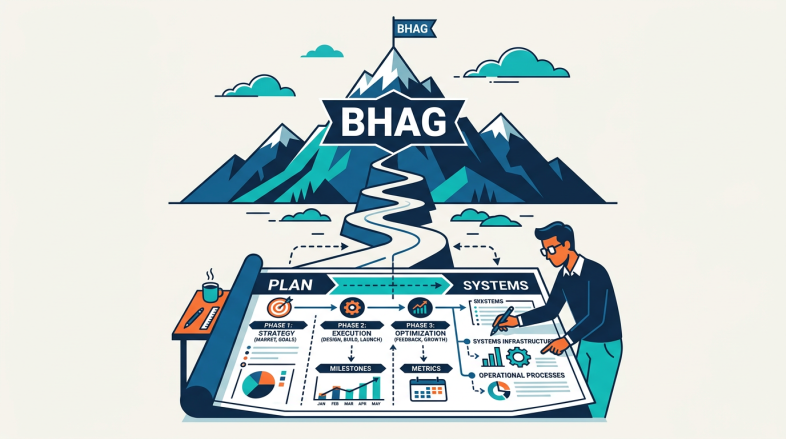
A goal setting execution strategy is simply the bridge between where you are now and where you want to be. It is the reverse-engineered path that turns a distant outcome into a series of actions you can take today.
Without this bridge, even the most inspiring goal becomes paralysing, because the gap between “I want to build a sustainable income online” and “I opened my laptop at 8am” is enormous unless you have mapped the steps in between.
The Problem With Big Hairy Audacious Goals
BHAGs, as Jim Collins originally described them, are meant to be ambitious enough to stretch you beyond your comfort zone. And that ambition is genuinely useful, because small, timid goals rarely produce the focus or energy needed to push through the inevitable hard patches.
But here is the tension. Most people significantly overestimate what they can get done in a week, and just as significantly underestimate what they can accomplish across a full year of consistent effort. This mismatch is why so many people abandon their goals inside the first month. They aimed big, tried to do too much too fast, hit a wall, and concluded the goal was unrealistic.
The goal was not the problem. The timeline and the plan were.
When you set a BHAG and immediately try to act on it at full scale, you are essentially trying to jump the bridge in one leap. A proper execution strategy builds the bridge one plank at a time.
How to Break Any Goal Down Into Actionable Steps
This is the part that actually works, and it is simpler than most productivity frameworks make it sound.
Start with your big goal. Write it down clearly. Make it specific enough that you would know with certainty when you had reached it.
Now ask one question: what has to happen before this goal is reached?
The answer to that question is your first sub-goal. Write it down.
Then ask the same question again about the sub-goal: what has to happen before that is reached?
Keep going. Keep breaking each milestone down into the thing that must precede it, until you eventually arrive at something you can do today. That first action step, the smallest concrete thing you can do right now, is where your execution strategy actually begins.
This approach works because it removes the paralysis that comes from staring at a distant outcome. Instead of thinking about the finished result, you are only ever thinking about the next step. And the next step is always manageable.
Why Consistency Beats Intensity Every Time
One of the most overlooked principles in goal execution is this: it is not the big days that build the result, it is the ordinary days.
The person who sits down every morning and does one focused thing towards their goal will, over twelve months, outperform the person who has three incredibly productive weeks and then disappears for two months.
This is especially true when you are building something online. Whether it is a niche website, an email list, or a small digital product, the assets compound. Each page you publish, each subscriber you earn, each small improvement you make adds to the previous one. But only if you keep showing up.
A solid execution strategy protects this consistency, because on the days when motivation is absent and life is chaotic, you do not need to figure out what to do. You already know. You just do the next thing on the list.
The Role of Daily Accountability in Execution
Knowing your next step is necessary. But it is not always sufficient.
Most people benefit from some form of external accountability, because our brains are remarkably good at convincing us that we deserve a day off, that we will catch up tomorrow, or that the task is not that urgent. Having a prompt, a check-in, or a coaching structure that brings you back to your plan each day short-circuits that tendency.
This does not have to be expensive or complicated. It just has to be consistent.
If you want a practical starting point, I built a simple tool that walks you through 8 questions to clarify your goal and your execution path, then sends a daily coaching email to keep you on track. It is straightforward, it is free to use, and it is designed specifically for people who are serious about making progress without the noise.
You can access it here:
https://kaizen-coach.surfer3l337.workers.dev/
A Final Thought on Goals and Action
Setting a goal is an act of optimism. Executing on it is an act of discipline. You need both, because optimism without discipline produces daydreams, and discipline without direction produces burnout.
When you combine a goal that genuinely excites you with a step-by-step execution strategy and the daily habit of doing the next thing, something shifts. Progress becomes visible. Momentum builds. And the gap between where you are and where you want to be gets smaller every single day.
That is not magic. That is just what consistent execution looks like over time.