
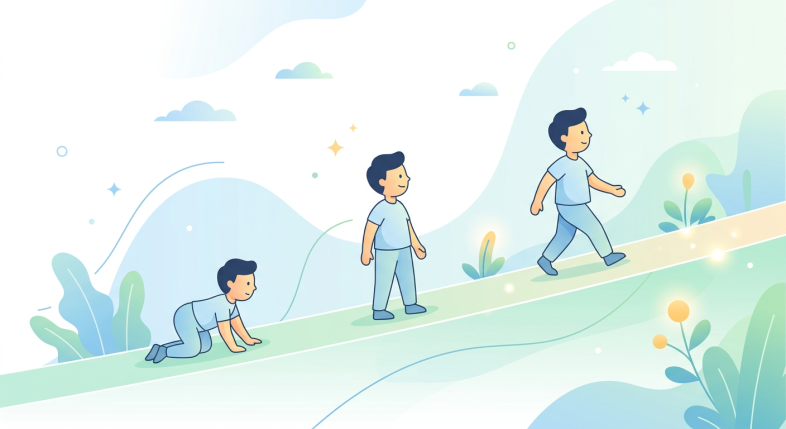
What crawling teaches us about building anything that lasts
Before a child takes their first step, they spend weeks on all fours, rocking back and forth, figuring out how their own body works. Most parents see this as a waiting room for the real event. But developmental psychologists have found something extraordinary hidden inside this seemingly simple stage: crawling is one of the most important things a human being ever does.
This is not a post about babies. It is about why most adults quit too early, and what a child’s nervous system can teach us about building income online after 50.
Why child development milestones start with crawling
When researchers began studying child development milestones, crawling was often overlooked. Parents and even some clinicians focused on sitting, standing, and walking as the markers that mattered. But the evidence tells a different story.
The specific movement pattern in crawling, right hand forward with left leg, left hand forward with right leg, fires signals across both hemispheres of the brain simultaneously. This cross-lateral rhythm develops what neurologists call bilateral coordination, the brain’s ability to integrate information from both sides of the body and both sides of itself. Think of it like laying down the wiring before you switch the power on.
Studies have linked strong crawling development to better spatial awareness, improved reading ability, and stronger fine motor skills later in childhood. When children skip the crawling stage entirely, some researchers have observed higher rates of difficulty with tasks that require the brain’s two hemispheres to work in concert.
The surf does not shape the coastline in a single wave. It comes back, day after day, and each pass carves the landscape a little deeper. Crawling works on a child’s nervous system in exactly the same way, which is why the milestone matters so much.
What happens after crawling: the compounding of milestones
Once the nervous system is primed through crawling, each new milestone builds on the last. Standing uses the balance and spatial awareness developed on all fours. Walking requires the cross-lateral rhythm already wired in. Running, jumping, catching a ball, reading a sentence left to right, all of it stacks on the foundation laid during those months on the floor.
This compounding of milestones is not unique to childhood. It is the same pattern that governs every meaningful skill a person ever develops.
Learning to feed yourself comes before learning to cook. Riding a bicycle with training wheels comes before riding without them. Reading individual words comes before reading full chapters. And in every case, the earlier stage does not feel significant while you are in it. It only reveals its importance in hindsight.
So why do adults abandon this pattern?
The quiet reason most people quit before the milestone arrives
If we all learned to walk through this layered, patient process of building one skill on another, why do so many adults give up on goals long before they reach the equivalent of walking?
I think it comes down to what we have been taught to expect. Somewhere along the way, decades of advertising and instant-result culture rewired our expectations. We began to believe that if results did not arrive quickly, we had done something wrong. We stopped trusting the crawling phase.
When I was building my first websites, I had that same problem. I would put in effort for a few weeks, see very little return, and quietly conclude that I had chosen the wrong path. What I did not yet understand was that I was simply in the crawling stage. The nervous system of the business had not finished forming yet.
The milestone was coming. I just kept stopping before I reached it.
This is why I built the Kaizen Coach. The Japanese concept of kaizen means continuous improvement through small, consistent steps. It is, in every meaningful sense, the adult equivalent of the crawling milestone. You commit to a small daily action. The system checks in with you the next day. If you missed it, there is no punishment, just the question asked again. If you kept going, the activity builds on itself.
Because the truth is, no one needs more information. What people need is a structure that keeps them moving through the crawling phase long enough to reach the milestone on the other side.
The child who crawls the longest often walks the strongest. The business builder who stays consistent through the early months, when results feel invisible, is the one who wakes up twelve months later to something that actually works.
If you want to stop quitting before your milestone arrives, come and see what the Kaizen Coach does: