
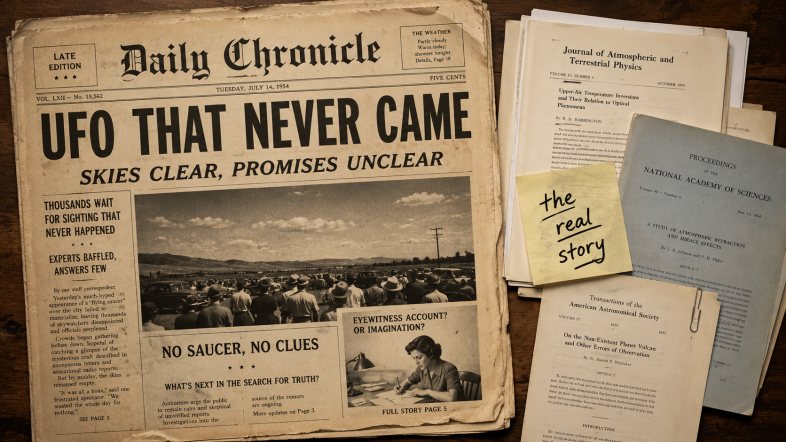
If you’re into pop psychology, you’ve probably heard this story.
A UFO cult was expecting an alien craft to land in Chicago on December 21, 1954. The plan was to whisk away the true believers just before a massive tidal wave wiped out the Earth.
December 21 came and went. No UFO. No tidal wave.
The cult was headed by a woman named Dorothy Martin, who communicated with the aliens via automatic writing — and occasionally over the phone. In the hours after the no-show, Martin received a message: the aliens had decided to spare the Earth because of the cult’s good work spreading the word.
Here’s where it gets interesting.
The cult, which had been secretive and hostile to outsiders, suddenly launched a full PR blitz. Announcing the good news to the world. It was no longer enough to be in direct contact with powerful aliens who’d saved humanity — everybody else had to know about it too.
I’ve written about this before. I got the story from Robert Cialdini’s book Influence, in the chapter on social proof. Cialdini got it from When Prophecy Fails, a classic of pop psychology written by researchers who’d infiltrated the cult to study it.
One problem.
The story appears to be tainted, exaggerated, or possibly made up. As many as half the cult members were actually researchers. One of them became a cult leader and started directing members on what to say and do — things that would look good in the book. Several real cult members simply walked after the UFO failed to show, which completely undermined the “cognitive dissonance” angle the book was built on.
This isn’t an isolated case. Over the past few years, a lot of the memorable social science stories have quietly fallen apart.
The marshmallow test — kids who delayed gratification did dramatically better in life? Doesn’t hold up when you control for some obvious background variables. The Harvard power poses research — standing like Superman raises testosterone and lowers cortisol? Sloppy data collection and wishful statistics. The Stanford prison experiment — ordinary people turned into monsters when given power over others? The guards were apparently coached on what part to play.
So what’s left when all the good stories are gone?
Boring, incremental progress. Findings that are unintelligible to anyone outside the field. A mountain of small, accumulated evidence that grows larger decade by decade, century by century. Not much of a cocktail party story.
Here’s why I’m telling you this.
I’ve been listening to some serious behind-the-scenes marketers lately — people who make real money and don’t primarily sell courses or build personal brands. One thing keeps coming up, in different words but the same idea:
“There’s really no secret to it. Just a bunch of small, incremental improvements over time that added up.”
Every one of them says some version of that.
We’re wired to look for the dramatic breakthrough. The story that upends everything we thought we knew. It sticks in the memory, travels well, feels satisfying. Our brains like a good before-and-after.
The real story of most successful businesses is less cinematic. Small improvements, boring fixes, consistent effort, accumulated over time.
That’s not the story anyone wants to read. But it’s the one that actually holds up.
Sound familiar?
Small things. Stacked. Waiting for the breakthroughs.
That’s been the theme around here for a while now.
The trick is doing enough experiments to find what works — and that means speeding up the boring stuff so you can run more of them.
That’s where this helps.