
When a simple game theory strategy beat the world’s cleverest code
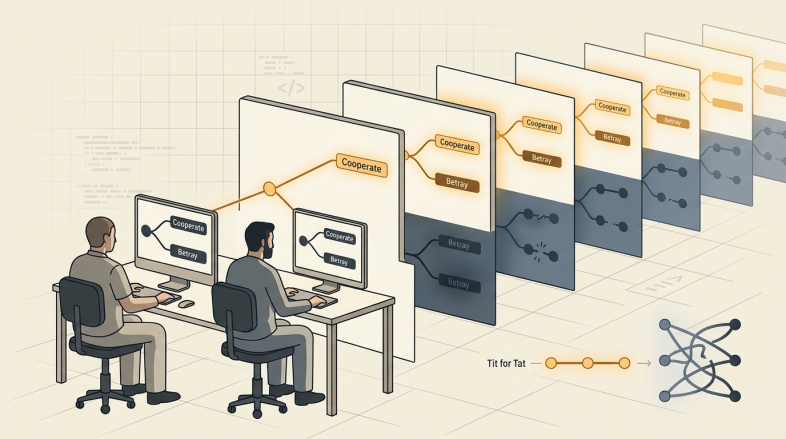
Around 1980, a political science professor named Robert Axelrod did something unusual. He ran a tournament. Not between people, but between computer programs, each one playing a game called the Prisoner’s Dilemma against every other.
Game theory experts from around the world sent in their best work. Some programs were sophisticated. Some used probabilistic logic. Some tried to anticipate and exploit patterns in their opponents. The entries came from economists, mathematicians and psychologists who had spent careers thinking about this stuff.
The winner used four lines of code.
Before I explain what it did, let me explain the game, because it matters and because it applies directly to how you build an online business.
The Prisoner’s Dilemma works like this. Two suspects are arrested and put in separate rooms. Each gets the same offer: dob in your mate and you walk free, while he gets ten years. If you both stay quiet, you each get one year. If you both dob each other in, you each get five years.
Here is the trap that makes this one of the most studied problems in all of game theory strategy. Whatever your partner does, you are individually better off betraying him. If he stays quiet and you betray, you go free instead of serving a year. If he betrays and you stay quiet, you get ten years instead of five. The maths always favours dobbing.
So both players betray each other. Both get five years. Neither gets the one year they could have shared if they had simply trusted each other.
That is the dilemma. Rational individual decisions produce a worse outcome for everyone.
But here is what changes everything: what if you play the same game two hundred times in a row with the same opponent?
Suddenly betrayal is not so clever. Because the person you just dobbed in is about to make a decision that affects you. Reputation, trust and reciprocity start to matter. The game theory strategy that works in a single round is a disaster across many rounds.
Axelrod’s tournament ran for two hundred rounds per pairing. The winning program, called Tit for Tat, did this: it cooperated on the first move, then copied whatever the other program did last. That was it. If you cooperated, it cooperated back. If you betrayed, it retaliated once, then returned to cooperating when you did.
Axelrod ran the contest a second time, told everyone how Tit for Tat had won, invited even more entries specifically designed to beat it, and ran it again.
Tit for Tat won again.
What made this strategy work where complexity failed? A few things stand out.
First, it was never the first to betray. It always offered good faith at the start. Second, it was not a pushover. It responded to betrayal immediately, so there was no benefit to exploiting it. Third, it was forgiving. Once a defector returned to cooperation, Tit for Tat moved on rather than holding a grudge. And fourth, it was simple enough that the other programs could read its behaviour and adapt to it. Clarity created trust.
The lesson that comes out of this is not really about game theory. It is about what happens when you think in repeated interactions instead of single transactions.
Most aggressive business tactics are single-game thinking. A misleading headline, a fake countdown timer, an inflated price crossed out to make a discount look bigger. These can work once. But the person who felt tricked does not come back. They tell others. The betrayal compounds in the wrong direction.
An email list is a game you play over and over. Every email is another round. The game theory strategy that wins across two hundred rounds is not the one that extracts the most from each individual interaction. It is the one that makes the other player want to keep showing up.
Tit for Tat always cooperated first. It extended trust before it was earned. That is a genuinely difficult thing to do in business, because it feels like vulnerability. But it is exactly what builds the kind of audience that buys from you repeatedly, recommends you to others, and sticks around when you have nothing to sell.
I built Prompt Builder as a pay-what-you-want product because that is cooperating first. It is a PDF that walks you through building a Claude tool that writes prompts for your business. You decide what it is worth after you have seen it.
That is the Tit for Tat move. I go first.
If this idea resonates with you, take a look: